
Delta County Court Records After Arrest
An arrest in Delta County creates jail and sheriff records first. Those may include an arrest report, booking sheet, fingerprint entry, property inventory, bond paperwork, and a booking photo if one is releasable. The Delta County Sheriff's Office is led by Sheriff Todd Tardiff, while the criminal court record begins when the Delta County Prosecutor's Office reviews the police report and authorizes a complaint or other charging document on behalf of the People of the State of Michigan.
The local path is narrow but important. Misdemeanor cases and felony first-stage matters are tied to 94th District Court. Felony cases can later move to 47th Circuit Court after bindover, waiver, or filing. For custody and booking details, use Delta County jail inmate records. For booking-photo questions, use Delta County jail mugshots. Court records after a jail arrest focus on filed charges, hearings, warrants, bond conditions, pleas, dismissal, sentencing, and the disposition that closes each count.
The Delta County Prosecutor's Office page and county directory identify Prosecutor Lauren Wickman as the local prosecuting attorney. That office reviews police reports, authorizes criminal charges, works with victims and witnesses, and appears in criminal cases for the state. A booking charge is not the same thing as a prosecutor-approved court charge.
The official Delta County Prosecutor's Office page shows the local office used in the charging process.
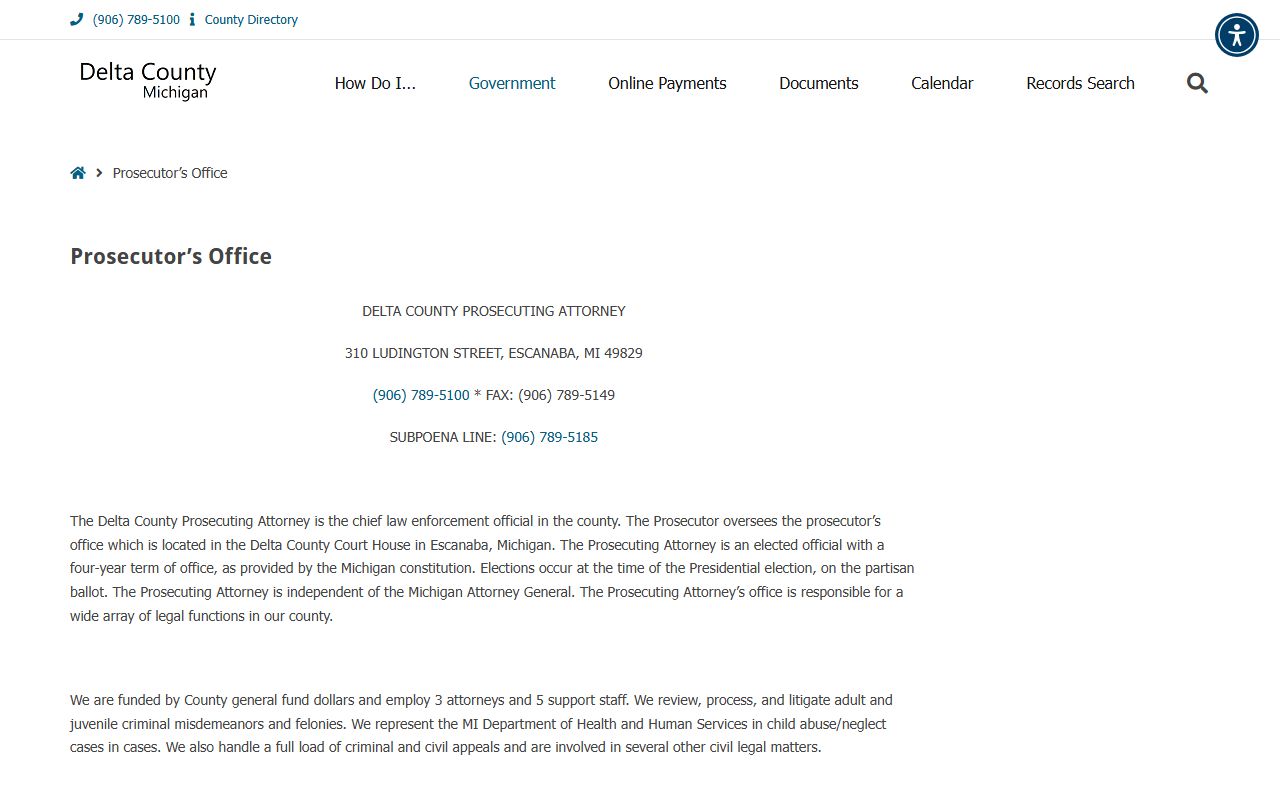
That office is the link between the law-enforcement report and the formal court case that appears in public court records.
Find Delta County Court Records
The main online route is MiCOURT Case Search, Michigan's public court case-search portal. MiCOURT is court-participation based, so a very new arrest may not appear until after the first appearance or filing. If a case is sealed, suppressed, nonpublic, or too old for the online view, the District Court, Circuit Court, or Delta County Clerk may be the better source.
- Start with the defendant's full name, spelling variants, and approximate arrest date.
- Search MiCOURT by party name or case number, and choose Delta County or the local court path when the portal asks for court location.
- Open the case result and read the charge list, hearing events, bond entries, and next court date.
- For felony matters, check District Court for arraignment and preliminary-exam events, then Circuit Court for the bound-over case.
- For certified copies, dispositions, or older records, contact the court or clerk rather than relying on a screen print.
The MiCOURT public case-search interface is the statewide portal used for many Michigan court records.
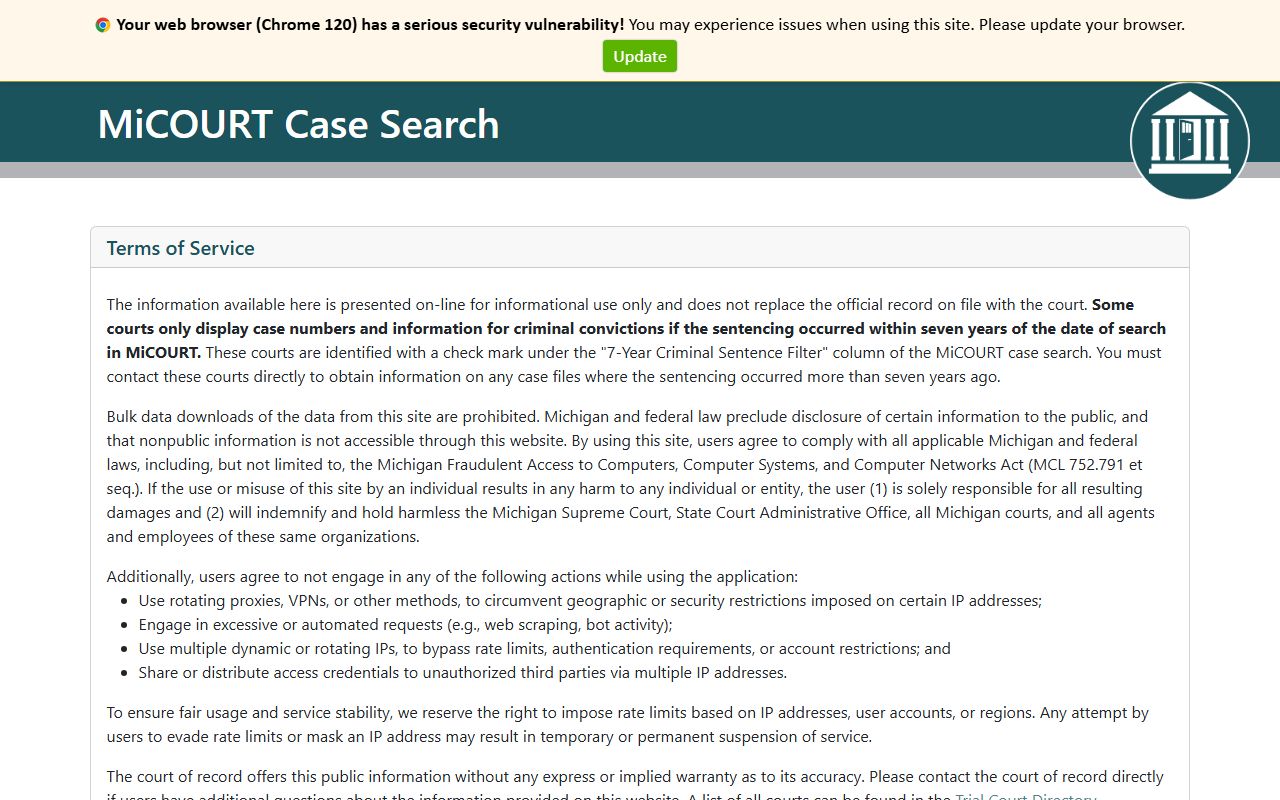
MiCOURT is useful after court filing, but it should not be treated as a live jail roster or a booking-photo database.
| Field Label | Type | Required | Options / Format Notes |
|---|---|---|---|
| Court / Court Type | Dropdown or filter | Usually selected by path | District, Circuit, Probate, or another participating court type. |
| County / Court Location | Dropdown or filter | Varies | Select Delta County or the specific local court where available. |
| Case Number | Text | No | Best when the exact case number is known. |
| Party Name / Last Name | Text | No | Use the defendant last name for criminal case lookup. |
| First Name | Text | No | Narrows common-name results. |
| Case Type | Dropdown or filter | No | Use criminal or traffic filters when available. |
| Date Range | Date fields | No | May filter filing or hearing dates depending on portal mode. |
District vs Circuit Court
Delta County court records after a jail arrest often start in District Court even when the alleged crime is a felony. The 94th District Court handles misdemeanor matters, traffic-criminal work, arraignment activity, bond review, and felony preliminary-exam stages. If a felony is bound over or otherwise filed at the higher trial-court level, the case proceeds in the 47th Circuit Court.
That split explains why one arrest can produce more than one public record path. A first court event may appear in District Court, while later felony pleadings, motions, trial events, sentencing, and some certified records may be tied to Circuit Court and the County Clerk. Search by name first, then use the case number to keep the District and Circuit entries straight.
| Court Path | Common Role After Arrest | Where It Helps |
|---|---|---|
| 94th District Court | Misdemeanors, traffic-criminal matters, arraignments, bond, preliminary stages | First appearance, misdemeanor status, early felony events, District Court bond route |
| 47th Circuit Court | Felony cases after bindover or filing, plus appellate and other jurisdiction | Felony filings, motions, pleas, trial, sentencing, older Circuit Court records |
| Delta County Clerk | Circuit Court records and clerk functions | Certified Circuit Court documents and clerk-held case records |
Charges After a Jail Arrest
Formal charges are not just a restatement of the jail booking entry. Law enforcement may arrest on one suspected offense, while the prosecutor may authorize different counts, amended wording, or no charge at all after review. In Michigan criminal practice, the first charging document is often a complaint. A felony that moves past the preliminary stage may later be charged by information. Indictments are possible but are not the ordinary local path described in the Delta County research.
| Document | What It Does | Delta County Use Context |
|---|---|---|
| Complaint | Starts many criminal cases and states the charge basis. | Often tied to arraignment and early District Court records after arrest. |
| Information | Sets out felony charges after bindover, waiver, or later filing. | Commonly tied to the Circuit Court phase of a felony case. |
| Indictment | Accuses a person through a grand-jury process. | Not the routine route shown by the local research, but still a charging-document type. |
Read the complaint or information with the register of actions. The register shows events. The charging document shows what the defendant is accused of at that stage. The bond order, warrant entries, plea, and disposition tell what happened next.
Delta County Charge Status
Charge status is the key reason to search court records after a jail arrest instead of stopping at the booking record. A booking entry may be stale within days. Court records can show whether a count is still pending, amended, reduced, dismissed, bound over to Circuit Court, resolved by plea, or ended in conviction. That status can matter for bond, employment limits, no-contact orders, victim notices, and later expungement questions.
| Status | Plain Meaning | What to Check |
|---|---|---|
| Pending | The charge or case is active. | Next hearing date, bond terms, attorney appearance, warrant status. |
| Amended | The prosecutor or court changed the charge language, count, or statute. | Compare old and new count text before assuming the original charge remains. |
| Reduced | The charge was lowered, often through plea negotiation. | Look for plea entries and final disposition. |
| Dismissed | The charge ended without a conviction on that count. | Check whether other counts remain pending. |
| Bound over | A felony moved from District Court to Circuit Court after the preliminary stage. | Search for the linked Circuit Court case. |
| Conviction | The court entered a judgment of guilt after plea, verdict, or other lawful disposition. | Review sentencing, probation, jail, prison, fines, and costs. |
Note: A charge is an accusation until the court enters a conviction or other final disposition.
Bond Records After Arrest
Bond information may appear in both jail and court channels. The sheriff's Posting Bond page says third-party bonds are not processed by the Delta County Jail and must be posted at Delta County District Court during business hours. The same page identifies 94th District Court at 310 Ludington Street in Escanaba and lists the court phone as 906-786-5106. Bonds paid with the Sheriff's Office are processed through the Canteen kiosk in the sheriff lobby at 2800 College Avenue, or online through eXpress Account.
Bond does not always mean release. A no-bond hold, bench warrant, probation or parole hold, federal hold, immigration detainer, or another jurisdiction's warrant can keep a person in custody even when one Delta County bond is paid. Court records after a jail arrest should be checked for bond amount, bond type, conditions, no-contact orders, and warrant recalls.
| Bond Type | Practical Meaning |
|---|---|
| Personal recognizance / PR | Release based on a promise to appear, sometimes with conditions. |
| Cash bond | Money paid directly through the allowed court or sheriff payment channel. |
| Surety bond | A licensed or approved bond agent posts bond under a fee or collateral arrangement. |
| Ten-percent bond | The court allows a percentage deposit when that option is ordered. |
| Conditional bond | Release with limits such as no contact, testing, travel limits, or check-ins. |
| No-bond / hold | Payment alone will not release the person because another order or detainer controls. |
Warrants and Court Records
No official Delta County Sheriff's Office active-warrant search page was located in the research. That means warrant checks should not depend on a public county warrant database. If a warrant led to a current booking, call the Delta County Correctional Facility at 906-786-3633. If the warrant is tied to a court case, MiCOURT, the District Court, or Circuit Court may show related docket events, but a docket is not a complete live warrant list.
- Arrest warrant
- A court order for arrest based on a complaint or probable-cause finding.
- Bench warrant
- A judge's warrant often issued after missed court or violation of a court order.
- Detainer
- A request from another agency to hold or notify before release.
- Search warrant
- An order to search a place or item, not a public person-lookup tool while active.
Charge vs Conviction Records
A Delta County court record after an arrest can show both accusations and final outcomes. Treat those terms with care. A charge can be pending, amended, reduced, or dismissed. A conviction is a court judgment after plea, verdict, or other lawful finding. Public case searches may display both, so the disposition line matters.
| Point | Charge | Conviction |
|---|---|---|
| Meaning | An accusation filed in court. | A judgment of guilt entered by the court. |
| Timing | Appears early and may change. | Appears after plea, verdict, or final adjudication. |
| Effect | Can affect bond and court conditions. | Can affect sentence, supervision, fines, and record consequences. |
| What to Read | Complaint, information, docket, amendments. | Disposition, judgment, sentence, probation or prison entry. |
Sealed vs Expunged Records
Michigan has set-aside and expungement laws, including the chapter beginning at MCL 780.581. Expungement does not mean every public mention vanishes from every place at the same time, and it does not turn a booking record into proof that no arrest happened. It changes what can be publicly accessed or treated as a conviction record under the governing court order and state law.
| Point | Sealed / Suppressed | Expunged / Set Aside |
|---|---|---|
| Public access | Hidden from ordinary public view by rule, order, or case type. | Conviction or record access is limited under Michigan set-aside law when eligible. |
| Record still exists | Usually yes, with limited access. | Often yes for limited official purposes, depending on law and order. |
| How to verify | Ask the court or clerk handling the case. | Use the court order and Michigan expungement process, not a roster page. |
| Limits | Juvenile, sealed, suppressed, and nonpublic records may not appear online. | Third-party reposts may need separate correction routes. |
Important: Delta County Inmate Population is not a consumer reporting agency, and its information may not be used for employment, housing, credit, insurance, or other FCRA-covered decisions.
Delta County Court Record Limits
Michigan's Freedom of Information Act, beginning at MCL 15.231, supports broad access to public records, subject to exemptions. Court files have their own court rules and access limits. Juvenile matters, sealed cases, suppressed records, some victim information, law-enforcement investigative material, and nonpublic personal identifiers may be withheld or redacted.
The county FOIA page is the local path for sheriff, jail, and county records that are not court-file documents. For court documents, contact the court or clerk that holds the file. For statewide conviction-history style searches, Michigan State Police criminal history resources are separate from MiCOURT and may involve fees and identity limits.